
From Domestic Pains to Global Gains: Suzanne Butcher, the Ozone Layer, and the Montreal Protocol
Suzanne Butcher grew up in Erie, Pennsylvania and joined the US Foreign Service in 1970, serving for 28 years. As deputy director in the State Department’s Bureau of Oceans and International Environmental and Scientific Affairs (OES), she played a key role in international negotiations that led to the 1987 Montreal Protocol. This landmark agreement phased-out the use of ozone-depleting chemicals and is widely recognized as one of the most successful international environmental treaties ever implemented.

Butcher joined OES in 1986, a year after scientists discovered a hole in the Earth’s protective ozone layer over Antarctica. Experts warned that damage to the ozone layer would allow potentially harmful ultraviolet energy to reach the earth’s surface, and public fears of skin cancer, DNA damage, cataracts, and other ailments quickly spread.
Resistance from political and industry actors, however, impeded efforts to confront this issue. The Reagan administration was firmly against regulations that would restrain industrial growth, and industry leaders – particularly chemical manufacturers – claimed curbing chlorofluorocarbons (CFCs), a major element in refrigeration systems, would be too expensive, cost jobs and make U.S. companies uncompetitive. The Environmental Protection Agency (EPA) had taken small measures, such as banning CFCs in aerosol cans, but knew that more had to be done to address the threat ozone depletion posed to human health. Butcher understood that an international agreement that would put all countries on the same footing might be the only way to win industry support.
Butcher worked with the EPA to understand recent scientific findings about the dangers of CFCs and went to the Department of Commerce and the U.S. Trade Representative to determine the impact of controlling CFCs on American business. She recalled the central challenge: “How to fit domestic regulatory action with international negotiations, with economic impact, with scientific knowledge that is developing as you are moving along? It was fascinating.”
Butcher integrated the best available science with domestic realities to inform America’s diplomatic strategy to “structure controls in a way that will achieve the environmental goal with the best economic efficiency.” After extensive interagency consultation, much of it coordinated by Butcher, the U.S. Government decided to push for aggressive international action: a 95 percent cut in global CFC production. Butcher drafted the instructions for our embassies overseas to pitch the American stance well in advance of the negotiations, giving the United States a much stronger position at the negotiating table.
“Neither the producers nor the consumers would bear all the costs.”
Suzanne S. Butcher
While she was still navigating domestic divisions on this policy, she was also overcoming opposition from foreign delegations like the European Community and the Soviet Union. The Soviets, in particular, wanted to accommodate planned industrial expansions while certain Europeans hesitated at holding back industry. Meanwhile, developing countries needed a grace period to avoid unreasonable short-term costs. Butcher remembers the compromise that finally worked: “We created a system that controls both production and consumption, so it would be most efficient and effective and neither the producers nor the consumers would bear all the costs.”
Butcher’s work to balance environmental responsibility with economic feasibility was central to the success of the Montreal Protocol, leading to the elimination of 99 percent of ozone-depleting substances and strengthening America’s place as a leader in multilateral negotiations.
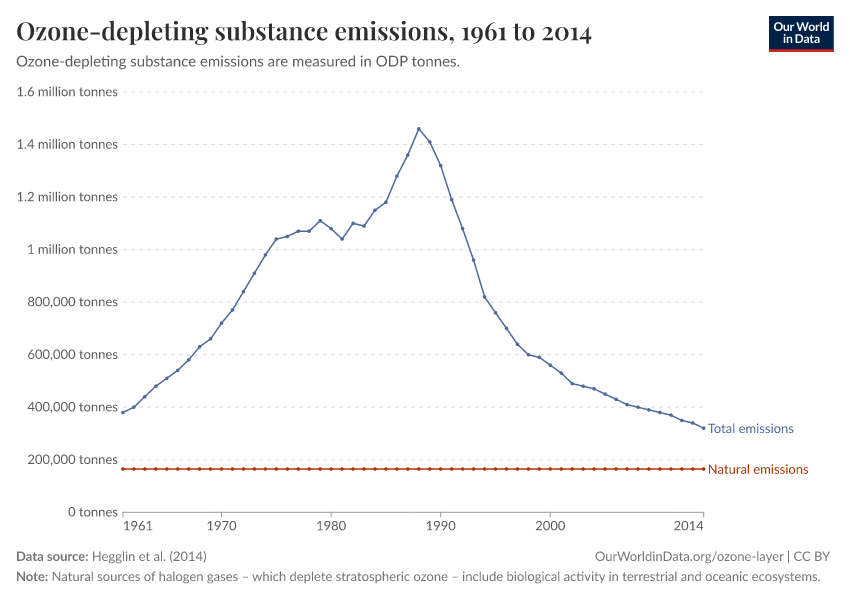
Our World in Data, Creative Commons Attribution 3.0