

The Collective and Patient Work of Diplomacy
Guy Martorana was born and raised in Monroeville, Alabama, the hometown of Harper Lee and the inspiration for her classic novel, To Kill a Mockingbird. Martorana, who served in the U.S. Agency for International Development from 2010 until 2025, explains how Lee’s story inspired his 15 years of public service building better partners for the United States.
“I grew up in the shadow of a story that shaped generations of Americans. From an early age, To Kill a Mockingbird was more than a novel. It was a lens for understanding the world beyond my hometown. Atticus Finch’s reminder that ‘you never really understand a person until you consider things from his point of view…until you climb into his skin and walk around in it’ stayed with me as I entered public service. It became a quiet guidepost throughout my career.”
As Martorana worked on international development in Ukraine, Afghanistan, Myanmar, Pakistan, and Côte d’Ivoire, one lesson remained constant for him: “Diplomacy takes time, and it depends on many people working together across agencies, governments, and communities to achieve shared objectives.”
Several moments shaped how he came to understand that reality and informed how he approached his final tour. “In 2013, I was in Kyiv,” he remembers, “during the early days of what became the Euromaidan movement. Walking through the city, I watched ordinary citizens organize themselves to demand accountability and a better future. Students, retirees, and professionals stood side by side. No single leader drove events. It was a collective effort sustained by a shared purpose. It showed me that meaningful change depends on local ownership and shared commitment rather than any single actor.”
In 2015, Martorana served as an accredited election observer during Myanmar’s general elections. “I was there to help support the spread of democracy, a foundational American ideal, but as I watched the long lines of voters from multiple ethnic groups, their pride and sense of ownership was clear. This moment reflected years of preparation by local actors, government institutions, and international partners and reinforced that democratic progress builds gradually through sustained participation and broad collaboration.”
In 2021, Martorana volunteered to support the evacuation of Afghan allies during the U.S. withdrawal from Afghanistan. “My role at Dulles Airport was small, guiding the evacuees to the next steps in their tumultuous relocation, but the experience underscored the importance of coordination across the U.S. government and with our external partners. It was a reminder that complex challenges require cooperation across institutions, especially during a crisis.”
“ Diplomacy takes time, and it depends on many people working together across agencies, governments, and communities to achieve shared objectives.”
Guy Martorana
His final tour in Côte d’Ivoire from 2022 to 2025 brought these lessons together in practice. “I managed a team that supported women’s political participation in municipal elections,” he remembers, “which increased from 15 percent to 30 percent by 2024. This outcome reflected years of work by the U.S. government, the United Nations, and international partners to build local capacity, as well as the implementation efforts of the Ivorian government, political parties, and the local women who led the initiative. It was their achievement, built over time through collective action.”
Martorana’s work also focused on conflict prevention to make Côte d’Ivoire a more stable partner for the United States. “We supported local peace committees that mediated disputes,” he recalls, “and community programs that used dialogue and art to rebuild trust in areas plagued by political violence. In some areas, farmer and herder conflicts were reduced to zero. Once again, it all came down to local leadership and sustained collaboration.
“Looking back, the throughline is clear. Each experience built on the last, reinforcing that diplomacy is a cumulative process. Our progress in achieving U.S. goals is often incremental, but it endures when it is shaped by those willing to see the world from another’s point of view and sustained by many working together toward a common goal.”
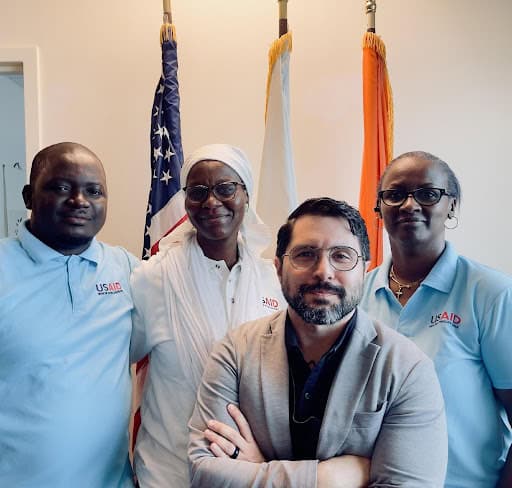
Photo courtesy of Guy Martorana.