

NATO Negotiations Bring a Shift in American Security
Born and raised in Throckmorton, Texas, William J. Galloway graduated from Texas A&M University before serving as an artillery officer in World War II. When he left the Army to join the State Department in 1948, he immediately became involved in treaty negotiations to create the North Atlantic Treaty Organization (NATO), the alliance that would ensure America’s security throughout the Cold War.
President George Washington’s opposition to “entangling alliances” guided U.S. foreign policy for generations, but attitudes began to shift after the devastation of World War II. “European security,” recalls William Galloway, the youngest member of the North Atlantic Treaty Working Group, “was no longer just European security. It was Atlantic security. We had experienced two wars because of not accepting that fact of life.”
Galloway became the right hand to Theodore Achilles, the State Department’s action officer for the treaty negotiations. Achilles immediately gave the young Texan two books to read on the 1787 Constitutional Convention in Philadelphia, making it clear to Galloway that he had just become part of something monumental. “I hung on to the tail of a comet in diplomatic activity,” he remembers, “which was high adventure to one of my age and limited experience.”
Key to the success of these negotiations were the close and positive relationships between Galloway and his American colleagues and their European counterparts. “We had such a near consensus in the working group that we’d help each other when needed to bring governments around to the common ground,” Galloway recalls. “If some particular initiative would be better received coming from the Europeans, we’d stand by and they would take the initiative,” he said. “During that period of six months to a year we became close friends.”
After debating membership requirements for the alliance, the working group focused on the heart of the treaty, the Article 5 commitment that an attack on one member would be considered an attack on all. This, according to Galloway, was the most entangling aspect of the alliance for Americans still partial to isolationist views, and when someone leaked the text to the New York Times during the negotiations, “official reaction by the U.S. and other governments was duly horrified. But the public did not seem to be too upset, and the debate calmed down. The trial balloon had worked.” Americans were ready for a security alliance.
“I hung on to the tail of a comet in diplomatic activity.”
William Galloway
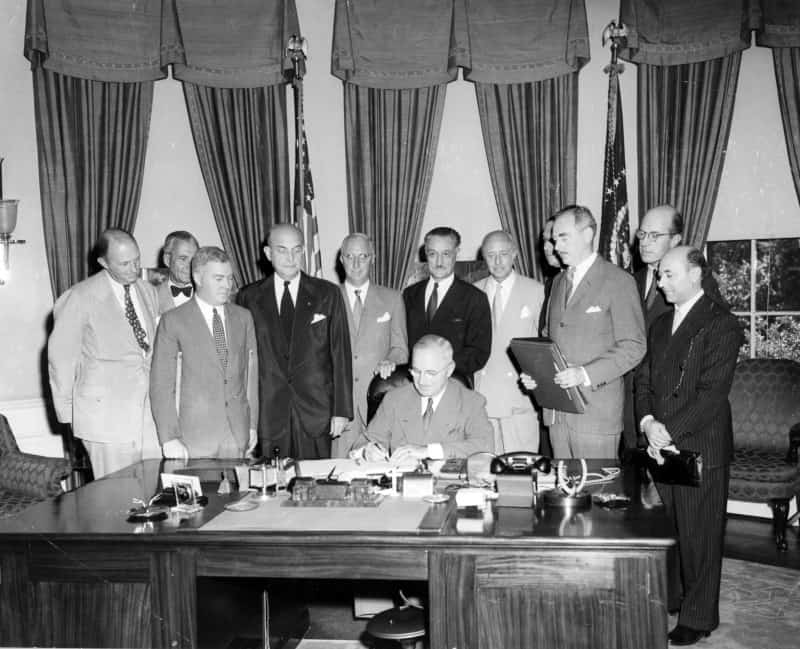
After President Truman signed the Atlantic Treaty in 1949, Galloway worked with his European counterparts among NATO’s Council Deputies to advance treaty implementation, debating what Galloway called “the main issue — the nature and extent of U.S. Military participation.” He navigated between European partners pressing for a major U.S. troop presence in Europe to deter Soviet aggression and those Americans who thought simply signing the treaty was enough of a deterrent. Galloway built relationships within the Department of Defense, becoming the first State Department officer to learn of the Pentagon’s plans to commit to a military deployment in Europe.
“From that point, the ‘O’ in NATO soon became a reality,” Galloway notes. “Plans for a military command structure emerged and the concept of the famous ‘Standing Group’ was unveiled.”
Galloway’s efforts as a party to the initial treaty Working Group and the North Atlantic Council Deputies positioned him at the center of a major shift in U.S. foreign policy that created the most successful alliance in history, a security commitment that brought America safely through the Cold War and continues to confront the challenges of the 21st century.