The Watergate affair was the most controversial political scandal to ever come out of the Oval Office and, along with Vietnam, marked a turning point in Americans’ distrust of the government. On June 17, 1972 five men were arrested as they tried to break into the Democratic National Committee (DNC) headquarters at the Watergate complex.… Read More "Watergate – Another Perspective"
Taiwan vs. China — Saber-Rattling Over The Third Taiwan Strait Crisis
Since 1979, the U.S. has maintained unofficial relations with Taiwan to preserve the U.S.’s recognition of the People’s Republic of China (PRC) and in support of the one-China policy. However, tensions have frequently flared up between Beijing and Taiwan over issues of international recognition and independence for Taiwan. One of the more notable cases was… Read More "Taiwan vs. China — Saber-Rattling Over The Third Taiwan Strait Crisis"
The Fight in Vietnam Arrives at the White House
In the late 1960’s, the United States had become polarized by the Vietnam War, as even many defenders were beginning to question the goals and tactics of the military. One such person was William Watts, who at the time had been promoted to the position of White House Staff Secretary for the National Security Council… Read More "The Fight in Vietnam Arrives at the White House"
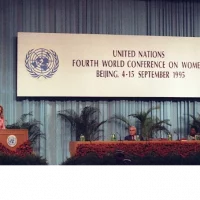
“If there is one message that echoes forth from this conference, let it be that human rights are women’s rights and women’s rights are human rights once and for all.”—First Lady Hillary Rodham Clinton At the United Nations’ 4th World Conference on Women, which was held from September 4-15, 1995, several countries united in support… Read More "The Beijing Conference on Women"
Managing a Massacre: The Ramifications of Tiananmen Square
The Tiananmen Square Massacre of June 1989, and the subsequent months of intimidation, deception and violence, shattered the façade of Chinese political solidarity and severely damaged Sino-American relations. The crackdown followed weeks of protests after the death of reformist leader Hu Yaobang, when tens of thousands of peaceful protesters gathered in Tiananmen Square to demand… Read More "Managing a Massacre: The Ramifications of Tiananmen Square"
Easter with Newt Gringrich
Easter is a time of joy, a belief in miracles, and reconciliation. But some people draw the line at people from another political party, as Joe Borich, who served as Consul General in Shanghai from 1994 to 1997, recounts. This excerpt is taken from “Shanghai Stories,” commemorating 30 years of the U.S. Consulate in Shanghai. Read More "Easter with Newt Gringrich"
Top Ten Things You Learn From a Hostage Situation
Sometimes it just ain’t easy working for the State Department. If you go through the lengthy history of the Foreign Service in the second half of the 20th Century, there are a surprising number of diplomats who have been held hostage. And while the situations and political context are very different, certain things do stand out.…
John S. Service – The Man Who “Lost China,” Part I
During the 1950’s hundreds of government employees, entertainers, educators, and union activists were accused of being communists by Senator Joseph McCarthy. Careers were ruined, reputations smeared as people found themselves on black lists and the victims of unjust persecution. In 1950, Senator Millard Tydings (D-MD) headed the Tydings Committee to investigate McCarthy’s claims of Communist penetration of the federal… Read More "John S. Service – The Man Who “Lost China,” Part I"
Oliver Platt — Actor and Foreign Service Brat
Oliver Platt is a talented character actor who has appeared in major blockbusters (X-Men: First Class), critically acclaimed TV series (West Wing, The Big C, starring Laura Linney), Broadway musical (Guys and Dolls), a movie with Charlie Sheen (1993’s The Three Musketeers) and a range of biopics (Casanova, Kinsey, Frost/Nixon). Oliver grew up in the…
The U.S. De-recognizes Taiwan in Favor of Communist China — January 1, 1979
“The Government of the United States of America acknowledges the Chinese position that there is but one China and Taiwan is part of China.” With this Second Joint Communiqué of the U.S. and China, issued on January 1, 1979, the Carter Administration no longer recognized Taiwan as a sovereign state, but rather preserved the “cultural,… Read More "The U.S. De-recognizes Taiwan in Favor of Communist China — January 1, 1979"