

Discovering and Ending a Genocide in Cambodia
Kenneth Quinn split his childhood between New York City and the American Midwest before joining the U.S. Foreign Service in 1967, which assigned him to the Civil Operations and Revolutionary Development Support program (CORDS) in Vietnam. He spent nearly six years there, and recalls a particular day in June 1973 while stationed in Chau Doc along the remote Cambodian border in South Vietnam’s Mekong Delta. From the top of Nui Sam (Sam Mountain), he looked across the Mekong River at the normally placid rice fields of southern Cambodia and was stunned – for miles and miles in every direction hundreds of plumes of black smoke were simultaneously rising straight up into the air.
“Every village across southern Cambodia was burning,” Quinn recalls, “all at the same time.” Over the next several days, more than 30,000 desperate Cambodians escaped across the border into Vietnam, and Quinn began to interview them. “The story emerged,” says Quinn, “that ruthless young radical cadres – referred to as the Khmer Krahom (Red Cambodians), but soon to be known to the world as the Khmer Rouge – had suddenly seized power in the southern provinces. They immediately forced every person to leave all of their possessions behind and march into the forests, where they were to begin new lives as part of a communal labor battalion. To ensure that the villagers understood that they could never return to their previous way of life, the Khmer Krahom burned every village to the ground.”
“Every village across southern Cambodia was burning, all at the same time.”
Kenneth Quinn
Quinn’s spot reports, handwritten on yellow legal pads, were picked up every few days by an Air America pilot who flew them to the U.S. Consulate General in the distant regional capital of Can Tho. In February 1974, Quinn submitted a 40-page analytical assessment with the title The Khmer Krahom Plan to build a Radical Communist Society in Southern Cambodia. “It outlined,” Quinn explains, “how under regional commander Ta Mok, the Khmer Krahom had destroyed traditional Khmer society; were eradicating religion; replaced reverence for the monarchy with the rule of “Anka” (the Committee); and had ubiquitous secret prisons for dissidents from which no one ever returned.
“I warned that this was the first act of a carefully orchestrated harbinger of the tragic genocide that was to come. Unfortunately, no one in the U.S. government accepted my reporting and analysis at the time, but it would subsequently be acknowledged to have been remarkably prescient when the Khmer Rouge captured Phnom Penh on April 17, 1975 and imposed this exact system on the entire country. It would leave close to two million people dead out of a population of only seven million after just four years of the radical Khmer Rouge rule. Henry Kissinger later said to me, ‘Your reporting on Cambodia was brilliant.’”
Two decades later, Quinn returned to the region as the U.S. Ambassador to Cambodia, when 25,000 radical Khmer Rouge troops still controlled much of the Cambodian countryside. Having seen during his time in Vietnam how roads could bring opportunity to villages where the Viet Cong had preyed upon desperation, he put a modest $13 million in U.S. assistance to work against the remaining Khmer Rouge strongholds. “It involved demining and then upgrading the farm-to-market roads into the Khmer Rouge base areas,” Quinn recalls. “The openness to increased agricultural trade that the improved roads provided so undermined the Khmer Rouge control that units began surrendering to the government. Pol Pot, whom my embassy was tracking in an effort to capture him, committed suicide.
“On the evening of March 6, 1999, I received a phone call from the Cambodian Prime Minister’s office informing me that the last Khmer Rouge leader had just surrendered. His name was Ta Mok, the same brutal Khmer Krahom commander who began that regime’s radical programs, on which I had first reported in 1973. I immediately phoned the State Department Operations Center in Washington to report that the United States had eradicated the most radical, mass-murdering, genocidal terrorist organization of the second half of the 20th Century.”
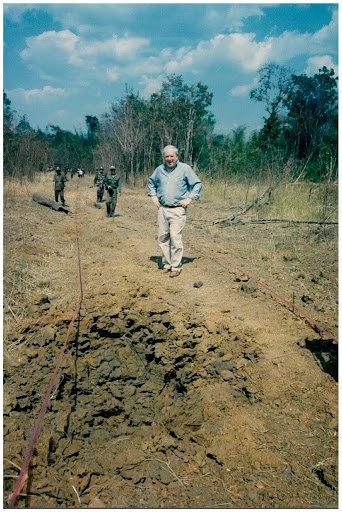
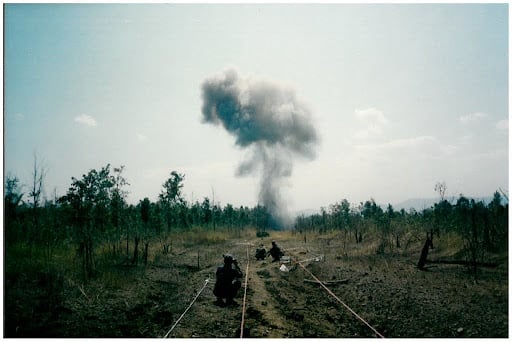
During an inspection of a demining project on a road into territory controlled by the Khmer Rouge, Ambassador Kenneth Quinn stands at left near the spot where a landmine has been removed. On the right, as Ambassador Quinn advances with the demining technicians, an anti-tank mine detonates on the road ahead of them, bringing home the seriousness of their task.
Photos courtesy of Ambassador Quinn.