From his crackdown on domestic opposition to his decision to invade Crimea and bomb U.S.-backed rebels in Syria, Vladimir Putin has increasingly become a thorn in the side of Western policymakers. His aggressive policies combined with his KGB background and over-the-top machismo have made him a bigger-than-life figure on the world stage, despite Russia’s flagging… Read More "Putin, The Early Years"
Day of Atonement, Day of Animosity – The 1973 Yom Kippur War
For Egypt and Syria, the 1967 Six-Day War was a bitter defeat at the hands of long-time foe Israel. They wanted to regain the Sinai and the Golan Heights while Egyptian President Anwar Sadat also wanted to reopen the Suez Canal. On October 6, 1973 they launched a surprise attack on Israeli positions in the Israeli-occupied territories on Yom Kippur, the holiest day in Judaism,… Read More "Day of Atonement, Day of Animosity – The 1973 Yom Kippur War"
From Victim of Nuremberg Laws to “Kissinger’s Kissinger”
The Nuremberg Laws were introduced by the Nazi government in Germany on September 15, 1935 to ostracize and impoverish its Jewish population. The laws prohibited marriages between Jewish and non-Jewish Germans, limited employment and revoked citizenship. Jewish workers and managers were fired and Jewish businesses sold to non-Jewish Germans at prices far below market value.… Read More "From Victim of Nuremberg Laws to “Kissinger’s Kissinger”"
Negotiating the End of the Yom Kippur War
Israel’s resounding victory in the Six-Day War of 1967 left the Arab states humiliated and looking to regain the swathes of territory they had lost. On October 6, 1973, Yom Kippur, the holiest day in the Jewish calendar, Egyptian and Syrian forces attacked Israeli positions in the Sinai Peninsula and the Golan Heights, shocking Israel… Read More "Negotiating the End of the Yom Kippur War"
Trouble in the Mountains: The Sino-Indian War, 1962
When two powerful countries cannot agree on the location of their shared borders, there is trouble. Such was the case with China and India in October 1962. China and India had long disputed ownership of the Aksai Chin, a mountain pass that connects Tibet to China’s Xinjiang province on the western side. On the eastern… Read More "Trouble in the Mountains: The Sino-Indian War, 1962"
Lost in Translation while Posted Abroad
Working as a U.S. diplomat overseas requires patience, composure, and the ability to communicate cross-culturally. Oftentimes, diplomats can speak multiple languages, or use interpreters to make their opinions known to another party. However, as is the case with any linguistic encounter, misunderstandings and miscommunication can often occur. In interviews with Charles Stewart Kennedy, Hans N.… Read More "Lost in Translation while Posted Abroad"
Opening an Embassy in the Land of Genghis Khan
Getting a new embassy up and running is a tremendous task, especially when the host city has an annual average temperature of thirty degrees Fahrenheit. Joseph Edward Lake was the second U.S. Ambassador to Mongolia, and the first to reside permanently in the country. He was charged with establishing a functional embassy in Ulaanbaatar and… Read More "Opening an Embassy in the Land of Genghis Khan"
Frenemies: Warm Encounters with Cold War Soviets
Just because the war between the two superpowers was cold didn’t mean that relations between U.S. and Soviet diplomats had to be frosty. While there were certainly some testy times, U.S. diplomats report that their relationships with Soviets were sometimes warm, funny, and congenial — especially if the Soviet officer was trying to convince them… Read More "Frenemies: Warm Encounters with Cold War Soviets"
Foundering Phoenix: Solidarity’s Turbulent Rise to Power
The path of Solidarity from dissident group to governance in the 1980s was far from smooth. Founded on September 17, 1980 at the Gdansk Shipyard, Solidarity (Solidarność) was the Soviet bloc’s first independent trade union. Solidarity’s ascent was of great symbolic importance, marking the end of five decades of Communist rule in Poland. Its leader, Lech… Read More "Foundering Phoenix: Solidarity’s Turbulent Rise to Power"
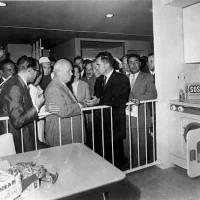
It was undoubtedly one of the most unorthodox – and therefore memorable – settings for a major political debate. On July 24th, 1959, the United States opened the American National Exhibition at Sokolniki Park in Moscow. The Soviets and Americans had agreed to hold exhibits in each other’s countries as a cultural exchange to promote… Read More "Nixon vs. Khrushchev — The 1959 Kitchen Debate"